Small vs Large Metal Detector Coil: Which Should You Use?
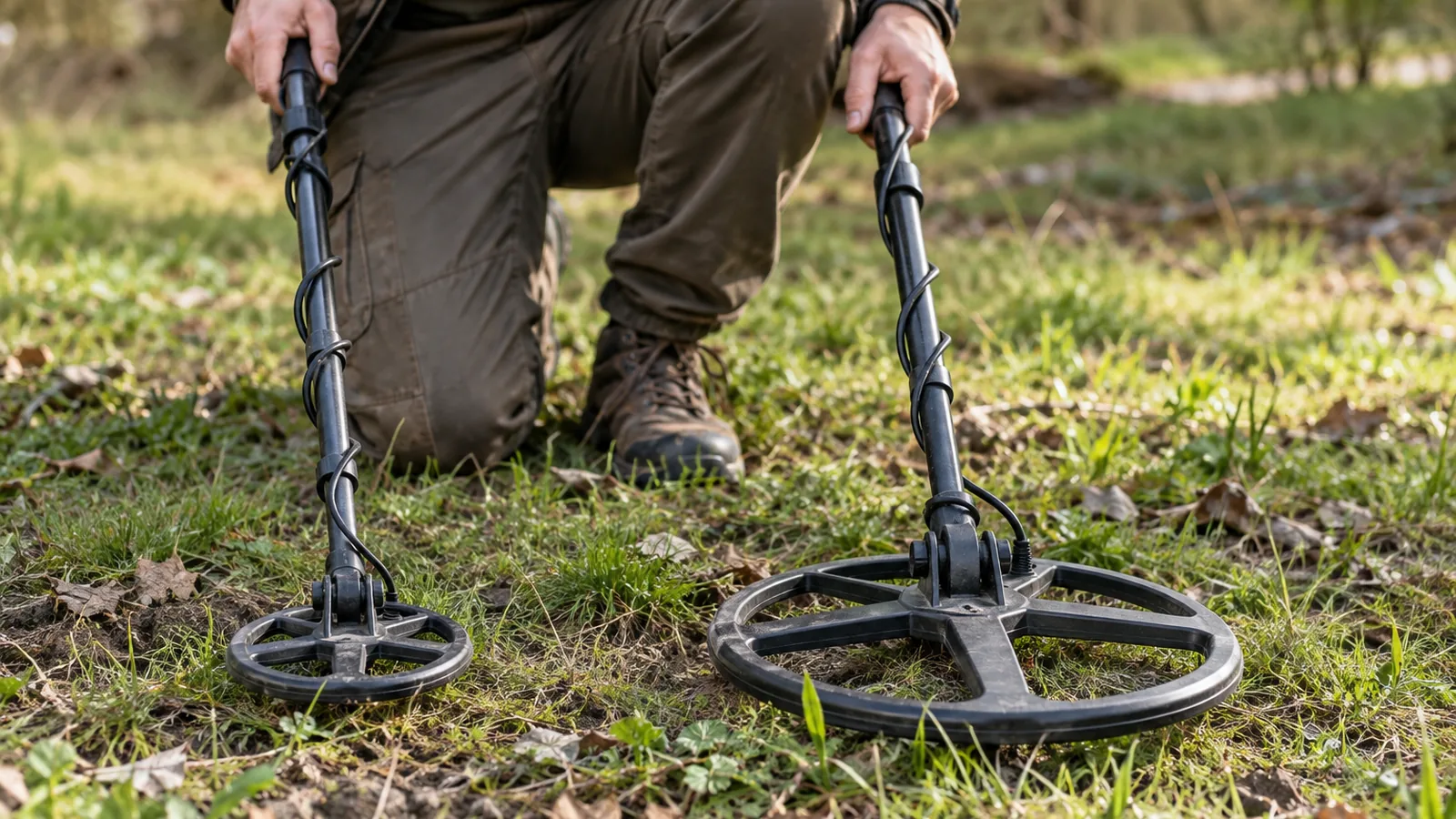
For small vs large metal detector coil choices, a small coil can help separate nearby targets, while a large coil covers more ground per sweep; coils over 11 in. are large. In cluttered ground, start with a small coil because it’s less likely to detect multiple nearby targets at once.
Should I use a small or large metal detector coil?
Quick answer: Use a small coil in trashy ground or for very small targets, and a large coil to cover open ground or search for larger, deeply buried targets. A small coil covers less ground per sweep, while a large coil covers more and may be less sensitive to small targets. For general coin hunting, start with an 8–9 in. medium coil; choose another size when clutter, target size, or coverage needs call for it. Before buying, check compatibility with your exact detector model.
How Do Small and Large Coils Compare?
Small coils cover less ground per sweep but concentrate their detection field; large coils cover more ground and generally produce wider, deeper fields. Garrett classifies coils under 6 in. as small and those over 11 in. as large.
| Coil size | Diameter | Ground covered per sweep | Nearby-target separation | Detection field | Typical use |
|---|---|---|---|---|---|
| Small | Under 6 in. | Less | Concentrated field can help isolate targets | Concentrated | Very small objects and trashy areas |
| Large | Over 11 in. | More | — | Wider and generally deeper | Large or deeply buried targets |
The table’s size categories and comparisons reflect Garrett’s guidance; Minelab also notes that larger coils may be less sensitive to small targets.
The main trade-off is coverage versus target detail: a larger coil can search an area in fewer sweeps, while a small coil’s concentrated field can help you pick out a desirable signal among nearby metal debris. A dash in the table means no supported comparison is available for that factor; it doesn’t mean the coil cannot separate nearby targets. A large coil’s wider, deeper field can suit searches for larger or deeply buried objects, but it isn’t a guarantee of greater depth in every setup. Detection results also depend on the target and ground conditions.
What Changes With Coil Coverage and Target Separation?
A larger coil generally covers more ground per sweep, while a smaller coil can make it easier to separate nearby targets in trashy ground. The trade-off is sweep efficiency versus control: your coil choice should match how much open ground you need to cover and how much metal clutter you expect.
With a smaller coil, you’ll need more sweeps to search the same area. A larger coil reduces that workload by covering more ground on each pass. That advantage matters most in open areas where you can sweep without repeatedly working around obstacles.
In sites with metal debris, a small coil’s more concentrated detection field can help you isolate a useful target from nearby junk. A larger coil is more likely to detect multiple nearby targets at once, which can make it harder to tell which response belongs to which object. That’s why a small coil is the better starting point for a cluttered patch, even though it takes longer to cover.
More coverage means fewer sweeps with a large coil, but it doesn’t guarantee a clearer signal or better results in every site. Detector design and ground conditions affect performance, so treat coil size as a practical trade-off rather than a universal rule.
Whichever size you use, keep your sweeps close enough together to avoid leaving gaps. For the MX5, Garrett’s manual recommends about 50% overlap between sweeps to maintain coverage at maximum depth. That recommendation is specific to that detector’s manual, so check your own model’s instructions for sweep guidance.
How Do Coil Size and Detecting Conditions Affect Depth?
Coil size affects potential depth, but no coil guarantees a set depth across different targets and ground conditions. For a coin-sized target, Garrett’s rule of thumb estimates detection depth at roughly the coil’s diameter, but that estimate isn’t a promise for every detector setup.
A target’s size, shape, orientation, and composition all affect how easily a detector senses it. Larger coils may be less sensitive to small targets, so choosing a larger coil for potential depth can make tiny objects harder to detect. Small coils have concentrated detection fields, which can help when you’re searching for very small objects.
Ground mineralization can limit depth by masking small targets, while ground balance can reduce mineralization noise and improve detection depth. Coil type also matters: in highly mineralized ground, a DD coil may outperform a concentric coil of the same size; in non-mineralized ground, a concentric coil may be more sensitive.
Note
Depth depends on the detector technology as well as the coil, target, and ground, so treat rules of thumb as estimates rather than promises.
A larger coil may also be more susceptible to electromagnetic interference, which can affect its performance in some conditions. Check exact model compatibility before buying: coil compatibility isn’t universal, and coils from earlier ACE models don’t work with the Apex detector.
Which Coil Should You Choose for Your Search?
Choose a small coil for cluttered ground and a larger coil for covering open ground or searching for large, deep targets; for general coin hunting, an 8–9 in. medium coil is a practical starting point. This small vs large metal detector coil choice depends on your targets and the sites you search most often.
If you hunt trash-heavy sites, use a small coil to work around metal debris and reduce the chance of detecting several nearby targets at once. Its concentrated field can also help you detect very small objects. The trade-off is slower coverage: a small coil searches less ground per sweep, so you’ll need more sweeps to cover the same area.
For open ground and larger targets, a larger coil covers more ground per sweep and generally creates a wider, deeper detection field. That can suit large or deeply buried targets, but larger coils may be less sensitive to small targets. A coil larger than about 15 in. can begin to miss coin-sized objects, so don’t choose a very large coil for coin hunting based on size alone.
For coin-sized targets, Garrett’s rule of thumb puts detection depth at about the coil’s diameter, but that isn’t a guaranteed depth for your setup. Target size, shape, orientation and composition, ground mineralization, and detector technology all affect depth.
Before buying, check exact model compatibility with the detector manufacturer. Coils aren’t universally compatible, so verify that the specific coil works with your exact detector model. If you mainly search mixed sites, favor a medium coil for general-purpose coin hunting, then consider a smaller or larger coil when your usual targets and ground make its trade-offs worthwhile.
Frequently Asked Questions
Can I use a different-size coil on my metal detector?
Yes, if the coil is compatible with your exact detector model.
Will changing coil size affect my detector’s settings?
Follow your detector’s instructions and adjust for your targets and ground conditions, which affect detection results.
Does a larger metal detector coil make the detector heavier?
It can, but coil size alone doesn’t establish how much the detector’s weight will change. Garrett lists light weight as one advantage of a general-purpose 8–9 in. medium coil, so consider weight and maneuverability alongside coverage when choosing a coil.
Conclusion
Before buying, confirm the coil is compatible with your exact detector model and check its manual for sweep guidance.
Sources
- Searchcoil Basics – Garrett Direct (garrett.com)
- usa.minelab.com (usa.minelab.com)
- garrett.com (garrett.com)
- usa.minelab.com (usa.minelab.com)
- garrett.com (garrett.com)
- usa.minelab.com (usa.minelab.com)