How to Choose a Metal Detector for Your Needs
To choose a metal detector, start with what you want to find and where you’ll search, then compare the features that fit those conditions. For wet salt or underwater use, check salt handling and the detector’s submersion rating before buying.
How do you choose a metal detector?
Quick answer: Start with what you want to find, where you’ll search, and your spending limit. Compare models for the modes, coil, ground handling, and water resistance that fit those conditions; for underwater use, check the whole detector’s submersion rating and maximum depth.
- List your target finds and search locations, then set a budget. No single price threshold fits every buyer.
- Match search modes to your sites: Park for high-trash areas, Beach for sand and surf, or Goldfield for nuggets.
- Compare coil size and design, target sensitivity, discrimination, and ground handling for your targets and ground.
- For wet salt sand or surf, check salt handling; for underwater searches, confirm the detector’s full submersion rating and depth.
- Compare controls, display, audio, and listed weight, then choose a model that meets your needs within your budget.
How to choose a metal detector step by step
List your target finds and search locations. Write down what you hope to find, such as coins, fine jewelry, or gold, and where you’ll search, such as trashy parks, open fields, dry sand, wet salt sand, or surf. Those choices help narrow the search modes and features worth comparing.
Set your spending limit before comparing models. Decide what you can spend, then compare detectors within that limit. The available evidence doesn’t support a specific budget or price threshold, so no single price serves as a universal cutoff.
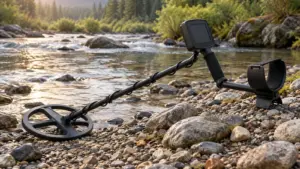
Identify the conditions the detector must handle. For wet salt sand or surf, look for salt handling intended for those conditions. For underwater searching, confirm that the entire detector is rated for submersion and that its maximum depth covers your planned use; if you’ll use headphones underwater, check that they’re submersible and compatible.
Match search modes, target response, and coil to your locations. Check that the model offers modes suited to your sites: examples include Park for high-trash areas, Beach for sand and surf, and Goldfield for nuggets. For small gold or fine chains, compare sensitivity to small, low-conductivity targets. A larger coil covers more ground per sweep but is less sensitive to small targets; a smaller coil is easier to maneuver in tight or trashy places. Compare discrimination and target separation too, since settings and target alerts differ by model.
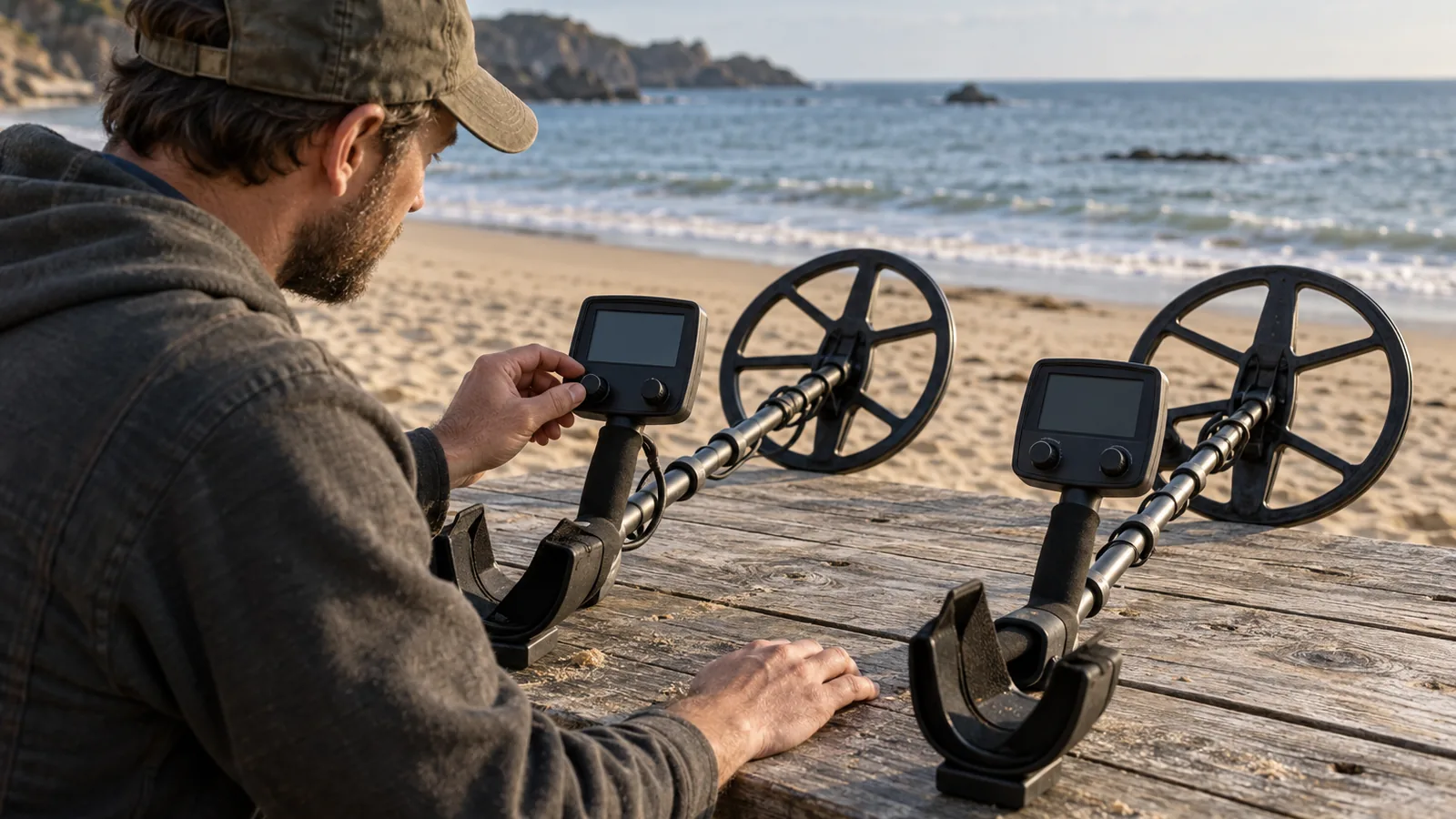
Check the controls and handling before choosing. Look for preset modes, adjustable sensitivity, a readable Target ID display, and clear audio tones if you want a simpler setup. Consider whether the controls and coil feel manageable for the locations you listed; don’t choose advanced settings alone as a reason to buy.
Verify each model’s specifications against your list. Check the exact search modes, coil options, salt handling, submersion rating and depth, and headphone compatibility you need. Don’t compare detectors by a single promised depth figure: performance depends on the target, ground, and noise conditions.
Choose the model that meets your requirements within your budget. Cross off any detector that lacks a condition you need, then compare the remaining options for target response, coil fit, and ease of use. If none meets your requirements, adjust the budget or search conditions before buying.
Which detector features fit your search?
Choose detector features by matching each one to your targets and search conditions, then weigh its trade-offs before you buy.
- Search mode: Pick a mode suited to the places and targets you expect. Minelab lists Park for high-trash areas, Field for varied target sizes, Beach for dry or wet sand and surf, and Goldfield for nuggets.
- Detection frequency: Check frequency guidance for the specific model, since stated uses can vary. On the Minelab X-TERRA 705, 3 kHz is specified for larger or deeper targets and higher-conductivity coins, while 18.75 kHz is specified for small shallow targets, gold nuggets, and fine jewelry.
- Target ID and discrimination: Treat Target ID as an estimate, not a guaranteed identification. Readings can vary with target size and conductivity, and gold rings can overlap with foil and pull-tab readings. Discrimination can use ferrous and conductive properties, but the settings and indicators vary across Minelab models. If you want to avoid some likely trash, compare how the model lets you adjust discrimination, and account for the chance of filtering out wanted targets.
- Ground handling: For iron-heavy or mineralized ground, compare ground-balance capability and target separation. Higher recovery speed can help separate adjacent targets in trash. The practical value depends on how much iron or mineralization you expect in your search area.
- Coil size and design: Larger coils generally cover more ground per sweep and can provide more depth, but are less sensitive to small targets. Smaller coils are lighter and easier to maneuver in tight or trashy areas, with less depth and coverage; they can also reduce the chance of detecting multiple targets at once. Concentric coils have a cone-shaped detection pattern useful for pinpointing, but need more overlap and can be noisier in mineralized soil. Double-D coils offer more uniform coverage and are preferred for ground balancing.
- Water resistance: For wet salt sand or surf, check that the detector has salt handling suited to those conditions; Garrett identifies Multi-Salt operation on the Vortex VX7 and VX9 for wet salt sand and surf. For underwater searches, verify that the whole detector is rated for submersion, then compare its stated maximum depth with your intended use.
Don’t choose by a depth figure alone: detection depth depends on the target, ground, and electrical or ambient noise.
What should beginners prioritize?
Beginners should prioritize simple controls, useful preset modes, manageable weight, and only the features their search conditions require. A preset mode gives you a clear starting point, while adjustable sensitivity lets you change how the detector responds to targets. Look for a readable Target ID display and clear audio tones so you can interpret signals without relying on advanced settings.
Choose controls you can understand and adjust without a long setup. Automatic ground balance and noise cancel can reduce setup work; on the Minelab EQUINOX 800, Auto Noise Cancel takes approximately 8 seconds. A pinpoint feature can help you locate a target before recovery.
Compare detector weight using the listed weight, not a vague claim that a model is “light.” The Minelab EQUINOX 700/900 weighs 1.26 kg (2.8 lb), while the EQUINOX 600/800 weighs 1.34 kg (2.95 lb). These examples give you reference points, but the right choice depends on which detector feels manageable for your intended use.
Avoid paying extra for advanced settings until you know why you need them. Match each feature to a real condition: for example, wet salt sand or surf calls for appropriate salt handling, and underwater use requires the whole detector to be rated for submersion. A Target ID reading is only an estimate; gold rings can produce readings that overlap with foil and pull tabs.
Before buying, make a short checklist:
- Controls: Can you understand the modes, sensitivity setting, display, and tones?
- Weight: Is the listed weight manageable for the way you plan to search?
- Features: Can you name a search condition that each advanced setting addresses?
- Limits: Does the detector’s capability match your location, and, for underwater use, its stated submersion rating?
If you can’t connect an extra feature to a specific need, prioritize ease of use and keep comparing.
Compare detector requirements at a glance
Match the detector’s mode, ground handling, coil, and water rating to your intended search conditions. Check the whole detector’s submersion rating before using it underwater.
| Search condition | Priority to compare | Specification or feature |
|---|---|---|
| High-trash areas | Search mode | Park mode |
| Varied target sizes | Search mode | Field mode |
| Dry or wet sand and surf | Search mode | Beach mode |
| Wet salt sand or surf | Salt handling | Multi-Salt operation is listed for the Vortex VX7/VX9 |
| Underwater use | Submersion rating | Whole-detector rating and stated maximum depth; Vortex detectors are listed to 16 ft (5 m), AT Series detectors to 10 ft (3 m) |
| Trashy or tight spots | Coil size | A small coil can reduce detection of multiple targets at once; an 8–9 in coil is described as a general-purpose option for coins and coin-sized targets |
| Iron-heavy or mineralized ground | Ground handling | Compare ground-balance capability and target separation; higher recovery speed can help separate nearby targets in trash |
| Small gold or fine chains | Target sensitivity | Compare sensitivity to small, low-conductivity targets; higher-frequency detectors often detect fine chains better than most coin detectors |
A beach mode alone doesn’t establish suitability for wet salt surf: check salt handling for those conditions, then check the whole detector’s submersion rating if you’ll take it underwater. For iron-heavy or mineralized ground, compare both ground balance and target separation, since they address different parts of the search.
Frequently Asked Questions
Do I need permission to metal detect in parks or public places?
Yes, get permission from the land manager before detecting, and check the rules for the specific park or public place. Access rules can vary, so confirm that detecting and digging are allowed there before you go. If permission is granted, ask about any limits on where you can search or recover targets.
What accessories should I buy with a metal detector?
Start with accessories that match your search conditions: compatible submersible headphones for underwater use, and a coil suited to the sites you plan to search. Check compatibility and ratings before buying.
How do I ground balance a metal detector?
Use automatic ground balance if your detector offers it, then use manual ground balance if you need to adjust the response for the ground you’re searching. Ground balance matters most in iron-heavy or mineralized areas, where you should also compare target separation and recovery speed. The control names and setup steps vary by model.
How much should I spend on my first metal detector?
Set a spending limit based on what you can afford, then compare detectors that meet your search needs within it. Spend more only when a feature addresses a condition you expect to face.
How do I test a metal detector before buying it?
Test the controls, display, tones, and preset modes, then check whether the coil is manageable for your search locations. If possible, compare the detector’s response to targets you care about, but treat Target ID as an estimate because readings can vary with target size and conductivity.
Conclusion
If your search is mainly parks or fields, choose a detector with modes suited to those locations and a coil you can manage there. If you plan to search wet salt sand or underwater, check for appropriate salt handling or a whole-detector submersion rating. Then compare models that meet your requirements for target response, coil fit, and ease of use, and choose one within your spending limit.
Sources
- garrett.com (garrett.com)
- Frequently Asked Questions | Minelab (usa.minelab.com)
- garrett.com (garrett.com)
- minelab.com (minelab.com)
- garrett.com (garrett.com)
- garrett.com (garrett.com)
- usa.minelab.com (usa.minelab.com)
- garrett.com (garrett.com)