How to Pan for Gold in a Stream
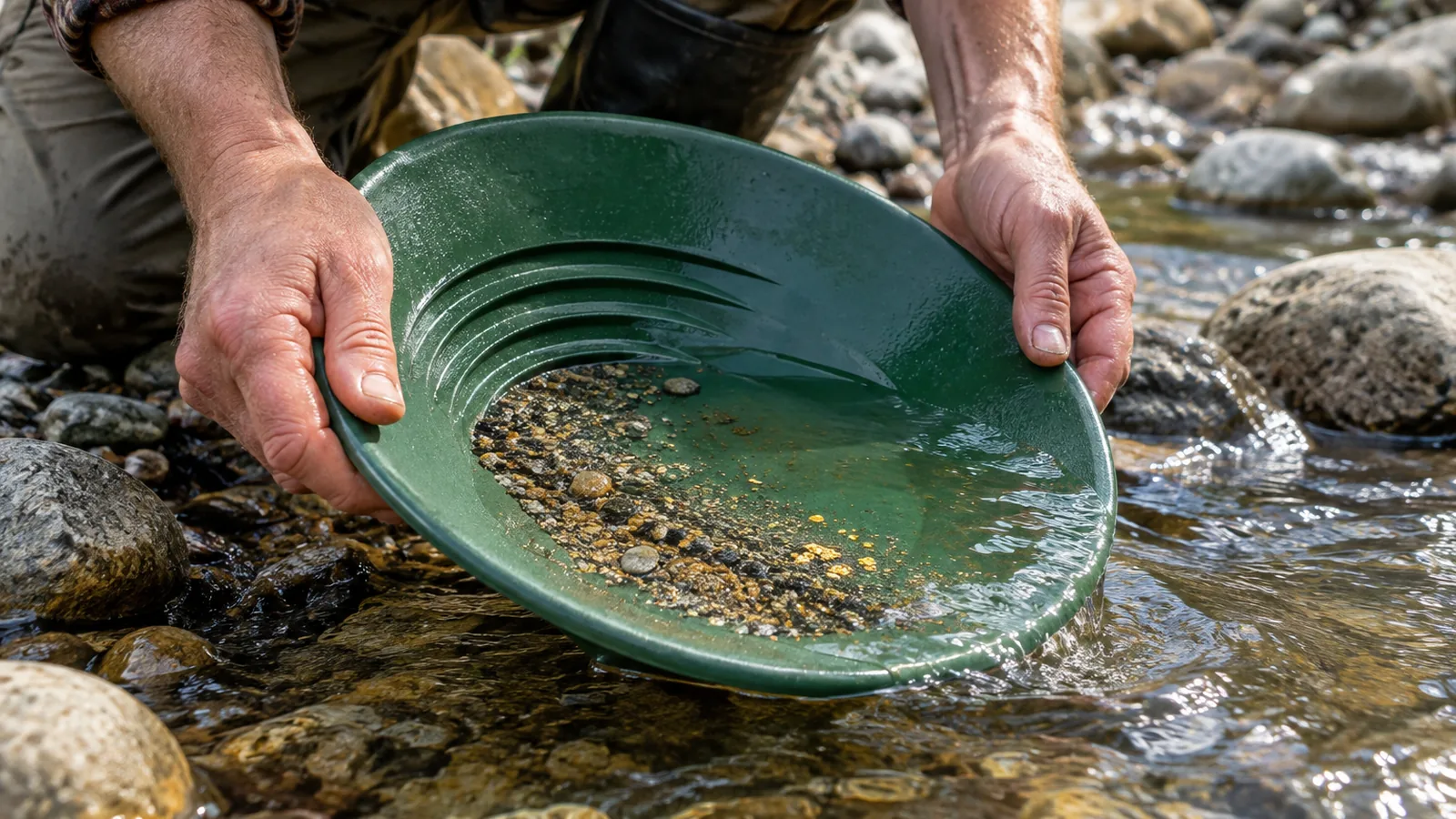
To learn how to pan for gold, fill a pan about three-quarters full of gravel, submerge it, shake to settle heavy material, then gently wash away lighter gravel. Don’t wash much material away before the heavy particles settle, or fine gold may wash out with it.
How do you pan for gold?
Quick answer: Use a gold pan in a mild current with at least 6 inches of water. Fill the pan about three-quarters full with gravel, settle the heavy material before washing, and inspect the concentrate slowly; use gentler swirls as the gravel gets low.
- Choose gravel near or behind a large rock or ledge, inside a bend, or where fast water slows.
- Fill the pan about three-quarters full and submerge it just below the water’s surface.
- Shake the submerged pan firmly side to side, then use gentle circles; repeat before washing away much gravel.
- Wash clay off larger rocks over the pan before removing them.
- Tilt the pan slightly away from you and swirl water side to side in small washes, alternating with underwater shaking; use gentler swirls as gravel decreases.
- Continue until about 2 cups remain, leave roughly 1 inch of water, then inspect and collect gold with slow swirls
Pan for Gold Step by Step
Choose gravel near or behind large rocks or ledges, inside bends, or where fast water slows, since heavy material can settle there. Work the pan in stages, letting heavy particles settle before washing away lighter gravel.
| Checkpoint | Amount |
|---|---|
| Gravel in pan | About three-quarters full |
| Material left for final washing | About 2 cups |
| Water for final inspection | Roughly 1 inch |
- Choose a spot. Look for gravel near or behind a large rock or ledge, inside a bend, or where fast flow slows.
- Fill the pan. Add gravel until the pan is about three-quarters full, then submerge it just below the water’s surface.
- Settle the heavy material. Shake the submerged pan firmly from side to side, then move it in gentle circles; repeat before washing away much gravel.
- Clear rocks and clay. Wash clay off larger rocks over the pan before removing them, because clay can hold gold.
- Wash in stages. Tilt the pan slightly away from you and swirl water from side to side to carry off lighter gravel. Alternate underwater side-to-side shaking with small, gentle washes; as the gravel decreases, use gentler swirls and keep the pan only slightly tilted.
- Inspect the concentrate. Continue until about 2 cups of material remain, then leave roughly 1 inch of water in the pan and use slow swirls to inspect and collect gold.
Choose Gravel That May Hold Gold
Start with gravel near bedrock, behind large rocks or ledges, or where fast water slows, since these spots can collect heavy gold-bearing material. Look for:
- Behind obstacles: Gravel on the downstream side of large rocks or ledges.
- Inside bends: Gravel along the inside edge of a stream bend.
- Slower water: Gravel where a fast current slows, including calm water below rapids.
- Natural traps: Pockets or depressions in gravel bars, natural riffles, and cracks in bedrock.
These are places where gold may settle, not proof that a site contains gold. Choose gravel from one of these features rather than taking it from an arbitrary stretch of stream.
You can compare small samples from different features, then focus on the one that leaves heavy material in the pan.
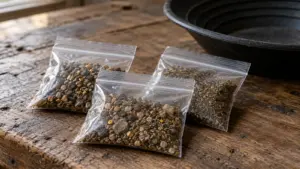
Black sand may remain with the heavy material, but black sand alone doesn’t confirm gold. Magnetite is the most common mineral identified as black sand. Treat it as a clue that heavy minerals are present, not as a reason to assume gold is there.
Keep Fine Gold in the Pan
Alternate firm, submerged side-to-side shakes with gentle, small washes of lighter gravel to reduce the chance of losing fine gold. Shake first so heavy particles can settle, then wash away only a little material at a time.
Use small washes, and pause to shake the pan underwater before removing more lighter gravel.
About 2 cups remain when the washing stage is done. Continue with controlled washes until you reach that amount, rather than quickly tipping out large amounts of gravel. Gold flakes tend to stay low in the pan as lighter grains wash away, but steady shaking and small washes help reduce the chance of losing fine particles.
Riffles on a pan can help retain heavier material as you wash away lighter gravel.
What Equipment Do You Need?
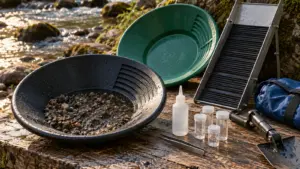
You need a gold pan and stream water; the available guidance supports those essentials, not a longer gear list. A 10–14-inch pan is a practical starting size for a beginner.
Washington’s geology handbook lists standard 10-, 12-, and 16-inch pans, with 12 inches described as probably the most widely used size. Choose a pan within the beginner range that you can handle comfortably; the cited guidance doesn’t establish that you need a particular pan shape or material.
Use stream water in the pan to wash gravel and inspect what remains. The U.S. Forest Service guide describes panning in a mild current with at least 6 inches of water; final inspection uses roughly 1 inch in the pan.
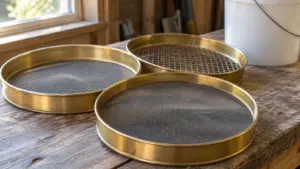
A shovel, classifier or snuffer bottle can help, but none is required to start panning. It also doesn’t provide product models or specifications beyond pan sizes.
Frequently Asked Questions
Can you pan for gold in any stream?
No, you can’t assume every stream is open to panning or contains gold. Access depends on land ownership, local closures, and existing claims, and useful gravel is more likely near bedrock, behind rocks, inside bends, or where the current slows.
Do you need permission to pan for gold?
Sometimes. The rules depend on the land and your level of disturbance: hand panning with negligible disturbance on BLM land is generally treated as casual use, but restrictions may apply; collecting on an existing claim requires the claimholder’s permission. On National Forest System land, prior notice or authorization may be required if your work causes more than insignificant surface disturbance.
How can you tell if the material in your pan is gold?
Gold is usually rich yellow, flattened or irregular, and malleable; a metal point dents or gouges it rather than making it crumble. Gold’s malleability helps distinguish it from brittle minerals such as pyrite, while mica is light and platy despite its gold-like color.
What should you do with gold after finding it?
Use a container to hold your find, then inspect small particles with a magnifier if needed. A snuffer bottle can help collect small gold particles. Keep the material separate from black sand and other grains as you collect it; a magnet can remove magnetic black sand, while gold itself is not magnetic.
What time of year is best for gold panning?
The available guidance doesn’t identify a best season, so choose a time when you can safely access the stream and work in its current. A mild current with at least 6 inches of water is the recommended panning condition; the final inspection uses roughly 1 inch of water in the pan.
Conclusion
If you’re new to panning, start with a comfortable pan and gravel from a bedrock crack or a spot where the current slows. If your first sample leaves heavy material behind, keep working that feature; if it doesn’t, try a different natural trap. Your next step is to collect a small sample and work it slowly, settling the heavy particles before washing away more gravel.
Sources
- fs.usda.gov (fs.usda.gov)
- fs.usda.gov (fs.usda.gov)
- Gold (pubs.usgs.gov)
- pubs.usgs.gov (pubs.usgs.gov)
- fs.usda.gov (fs.usda.gov)
- usgs.gov (usgs.gov)
- garrett.com (garrett.com)
- dnr.wa.gov (dnr.wa.gov)
- edit.blm.gov (edit.blm.gov)
- blm.gov (blm.gov)
- fs.usda.gov (fs.usda.gov)
- fs.usda.gov (fs.usda.gov)
Gold Weight and Value Calculator
Convert gold between grains, grams, pennyweight and troy ounces, apply karat or fineness, and estimate value from a spot price you enter.